Does pelvic floor therapy help diastasis recti?

Pelvic floor physical therapy is very helpful in treating diastasis recti.
Now, I get it. You might be thinking: How can working on my pelvic muscles help heal muscles that are located in my stomach?
That's where the magic is! Pelvic floor therapy is much more than just the pelvic region. I'll talk about how the pelvic floor is involved throughout this blog, but the main reason that pelvic therapy can help you heal your diastasis is that the abdominal muscles are a part of what you know to be "the core".
The often-overlooked part is this: the core is much more than just the abdominal muscles.
It’s actually a canister.
Imagine a soda can.
One side is your abdominal wall, or your core muscles. Visually, you see your rectus abdominis muscles.
The other side is the muscles along your spine.
The top is your diaphragm, the canopy-shaped muscle which helps you breathe.
The bottom is your pelvic floor.

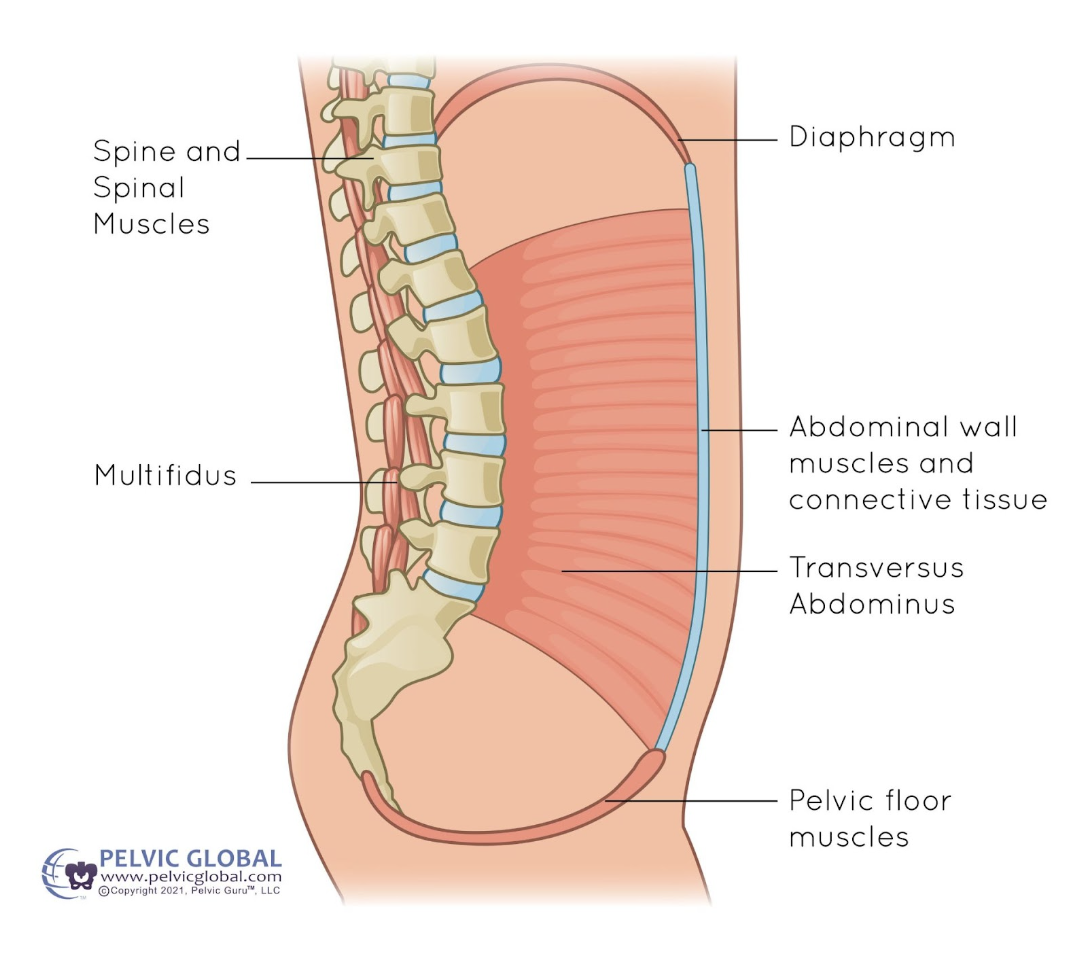
Image used with permission via Pelvic Global, LLC
To heal diastasis, you have to treat the core as a whole, because all of these units function together.
This means you must include the pelvic floor and address pelvic floor function during treatment.
Now, let's talk about how pelvic floor therapy actually helps diastasis recti.
What is diastasis recti?
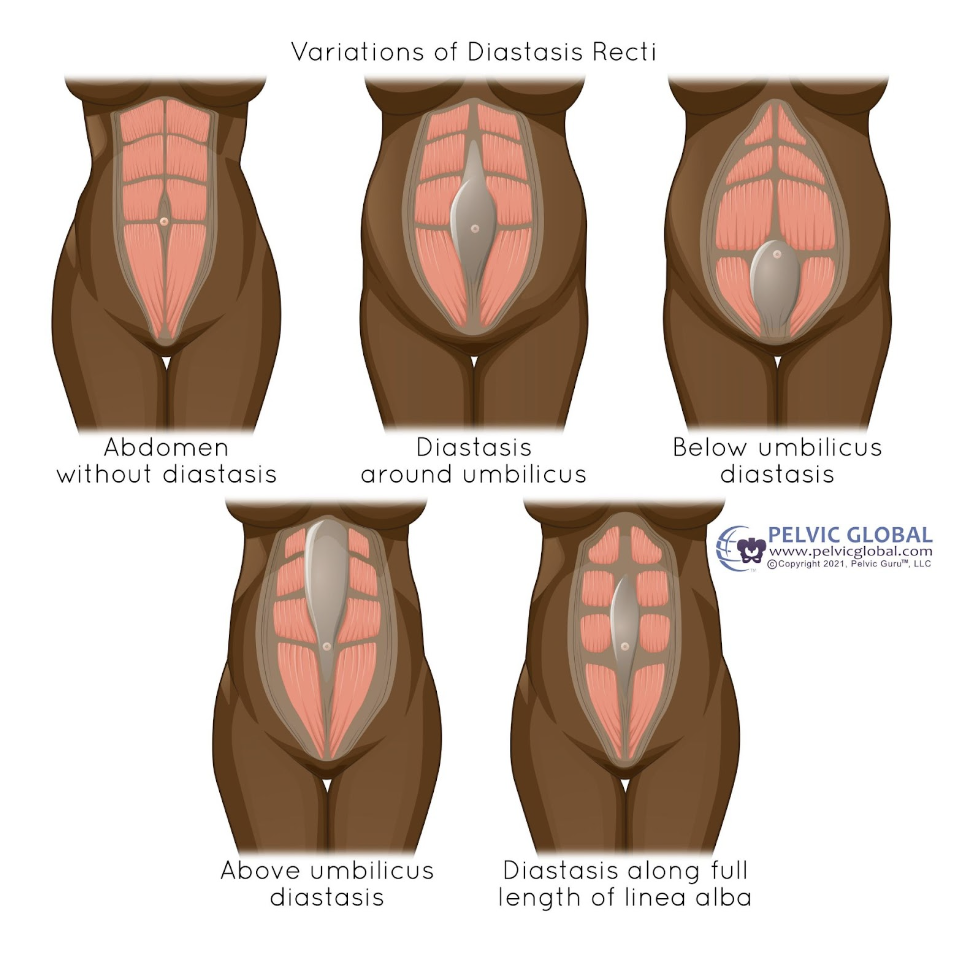
Image used with permission via Pelvic Global, LLC
First, let’s talk more about what a diastasis recti is.
In short, it is “a separation of the abdominal muscles.”
Typically, you may see or feel a gap in your abdominal muscles. It runs from your sternum to your pelvic bone.
Diastasis recti occurs when the two halves of the six-pack muscle separate along the linea alba, a strip of connective tissue that runs down the center of the abdomen.
This can occur for a variety of reasons: pregnancy or other rapid abdominal weight gain, poor pressure management with heavy lifting, genetics, etc.
Many patients with a diastasis recti (DR) worry about how it looks. A diastasis can make the stomach appear distorted, which can be bothersome. This is especially true during pregnancy and postpartum when struggles with body image are already common.
But from my perspective as a pelvic PT, having an excessive diastasis recti is a cause for concern because it can often go along with having a weaker "deep core", which can in turn be linked to a host of other issues such as lower back or pelvic pain, urinary incontinence, or pelvic organ prolapse.
As I mentioned above, the core is made up not just of the ab muscles, but also the back muscles, the diaphragm muscle (which sits under the rib cage), and my personal favorite, the pelvic floor muscles.
If the deep core abdominals (especially the transverse abdominis) are weak, then the core won’t be able to work as efficiently as a whole, and there will be more strain on other parts of the core, such as the back or the pelvic floor, leading to the aforementioned issues.
Here's the thing... While getting rid of your diastasis can be a goal, we need to optimize your deep core mechanics, which can contribute to a smaller diastasis overall and mitigate any other symptoms you may be experiencing.
Some other thoughts:
You can have a diastasis recti and not have any issues at all. → Even if you have a separation, you may not experience any issues if you can still properly engage your core during movements!
Even if you are having problems due to your diastasis, there’s plenty to work on that can help it improve (and yes, it's more than just core exercises and kegels).
You don't have to have been pregnant to have a diastasis!
Signs you might have a diastasis
If you're wondering whether or not you have diastasis, check out my blog post to learn how to tell if you have diastasis from the comfort of your own home.
Here are some common things you may notice/symptoms of diastasis recti:
You may be able to feel or see a gap between the two sides of your abdominal muscles
When you are lifting, pressing, or pulling, you may notice that a gap appears between your muscles while exerting force
You may feel weak in your core area or, as some patients explain, "hollow" in that area
A coning or doming shape in your abdomen area while performing sit-ups, heavy lifts, pull-ups, and more.
What pelvic floor therapy actually involves
When you work with a pelvic floor physical therapist, you'll receive a full evaluation first.
From that evaluation, your provider will be able to gain some insight on a few different things:
Do you have diastasis recti?
If you do have a diastasis, when is it present? At rest? During activity? Only in certain positions?
Is there corresponding pelvic floor dysfunction, pelvic floor weakness, or poor coordination of your core?
What is the quality of your abdominal muscle function (both your deep and superficial core) during activities
A full understanding of what exactly your goals are (lifting, running, playing with your kids) and a plan to get you there
Pelvic floor therapy will focus on addressing the findings above.
Addressing the system as a whole, and the coordination of the system, will help heal the system as a whole.
This means that we will:
Reduce excessive diastasis
Gain core control and coordination to help decrease likelihood that your diastasis will get worse as well as improve breathing and bracing mechanics
Avoid symptoms that come about secondary to diastasis like leaking, back pain, pelvic pain, and more
Determine what exercises are safe and effective outside of PT (ie: CrossFit, pilates, etc.) as well as give you strategies so that you can do whatever type of exercise that you prefer to utilize to stay active
Monitor core coordination during activity, identify which activities increase diastasis symptoms, and determine specific coordination and strengthening exercises to help you return to these daily activities without fear of worsening your diastasis.
This is more than just "brace your core!" and "do a Kegel!" (or 5 million Kegels). We want to improve core strength and functional use of your core.
Where to find pelvic floor therapy in Durham for diastasis recti
If you are local to the Durham area and are looking for a pelvic health provider with expertise in treating diastasis, I'd love to work with you. I offer pelvic floor therapy in Durham with the goal of whole-body integration and treatment specific to your goals.
That's a fancy way of saying that I offer pelvic PT, but we go way beyond just your pelvic and basic Kegel exercises.
I've worked with folks who are pregnant and have diastasis, those who are postpartum, and those who have not been pregnant before but can visually see coning in their core, especially while exercising.
To get started, feel free to reach out to schedule with me by filling out the contact form located here.