Does queefing mean your pelvic floor is weak?
Vaginal flatulence, commonly called queefing, occurs when air enters the vaginal canal and is released during movement, exercise, sex, or position changes. It is a normal bodily function and is not, on its own, an indicator of pelvic floor dysfunction.
Pelvic floor muscle tone and coordination can influence how easily air enters and accumulates in the vaginal canal. However, queefing is one of several possible symptoms in cases like pelvic organ prolapse or stress incontinence, not the defining sign of a weak pelvic floor.
Pelvic floor physical therapy can help assess the full picture when queefing occurs alongside other symptoms like leaking, pelvic pressure, or pain. A thorough evaluation looks at coordination, timing, and relaxation, not just muscle strength.
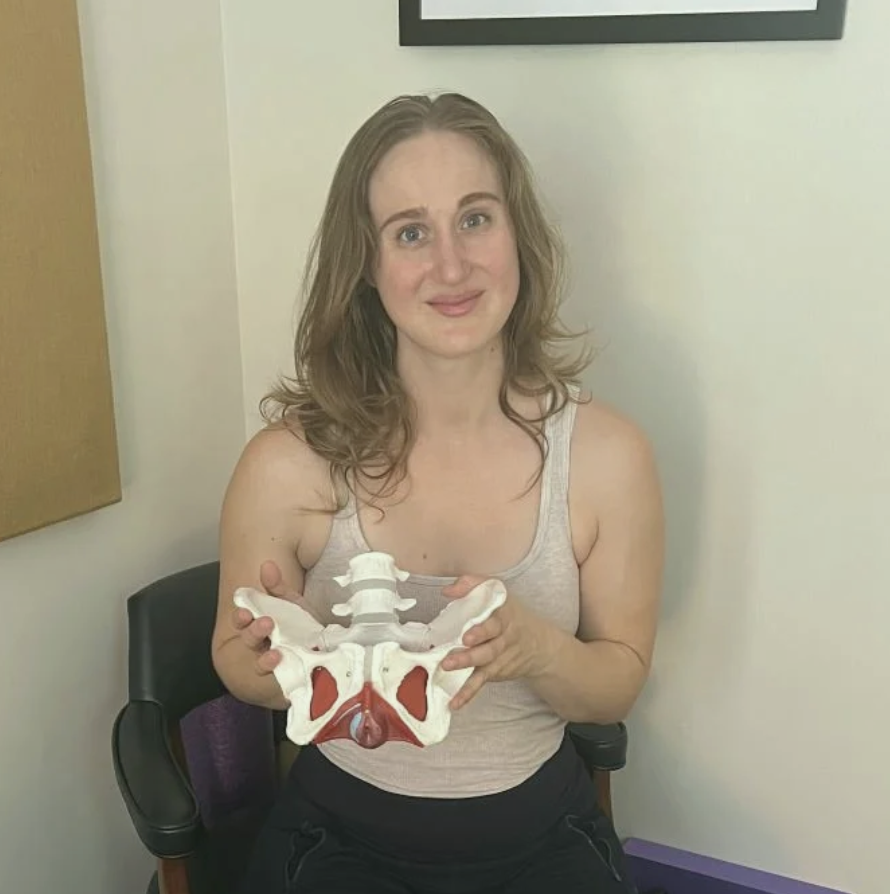
If you're experiencing queefing, or vaginal flatulence, you're likely wondering why it's happening and what you can do about it.
I get it. It can be embarrassing, especially when you don't even know why it's happening or if it started happening suddenly.
And even though it is so common (according to the European Journal of Obstetrics & Gynecology and Reproductive Biology and research by Neels et al., 2017, 69% of people report experiencing it), it is rarely discussed openly.
As a pelvic floor physical therapist, I want to break down what queefing actually is, why it happens, and when, if ever, it's something worth addressing.
What queefing actually is
Queefing is the sound that occurs when air gets trapped in the vaginal canal and is released. It's usually odorless and sometimes called "vaginal gas" or "vaginal wind."
This makes it different from anal flatulence, as it is not gas from your digestive tract.
Because the vagina is not a sealed space, air can enter during movement, sex, exercise, or certain positions, and when it exits, it makes a sound.
This means it's a completely normal bodily function and is not a direct indicator of pathology or anything wrong, and vaginal queefing alone does not mean that you have pelvic floor dysfunction.
Specific movements and positions where queefing is present
Certain movements and positions are more likely to allow air into the vaginal canal during sexual activity.
Research by Homoda et al., 2024 shows that vaginal noise, or queefing, happens with many activities. In order of prevalence:
With intercourse
With sitting
With rapid walking
In the squatting position
During a period
Lying down
Defecation
Prolonged standing
If you do CrossFit or gymnastics, you may also notice it when you're doing any handstand exercises.
And some folks report it happening with inserting or removing a tampon or menstrual cup.
Other common positions and movements that have been shown to lead to vaginal noise:
Positions during sex that change the angle or depth of penetration
Lower body exercises like squats, deadlifts, or movements that involve excessive hip flexion
Inversions or positions (like a handstand mentioned above) in yoga, pilates, or CrossFit
Transitions between positions quickly
During these movements, the pelvic floor and vaginal walls shift. If air gets in, it has to come back out. The sound you hear is just that, air moving through a canal.
The connection to pelvic floor function
Queefing is not automatically a sign of a weak pelvic floor.
A weak or underactive pelvic floor can contribute to conditions like leaking urine, pelvic organ prolapse, and feelings of heaviness in the pelvic region. Queefing on its own is not a reliable indicator of any of those things.
That said, there are situations where pelvic floor function does play a role.
If the pelvic floor muscles have reduced tone or coordination, the vaginal walls may have less structural support, which can make it easier for air to enter and accumulate.
In those cases, queefing may be one of several symptoms. Not the only one, and not the defining one.
Pelvic floor tension can also be a factor. An overactive or hypertonic pelvic floor can affect how the vaginal canal responds during movement, which may contribute to air trapping in different ways.
The point is: it's more nuanced than "queefing equals weakness."
It's also not true in both ways. An example: Everyone who queefs does not have pelvic floor dysfunction. But vaginal noise is reported as a symptom in 69% of women with pelvic organ prolapse. It is also reported in 73% of women with stress incontinence.
It's one of multiple symptoms of these pelvic floor issues, not the defining symptom of weak pelvic floor muscles. And similarly, if you don't experience vaginal noise, that doesn't mean you have a strong pelvic floor, either. You simply don't experience that one normal bodily function.
When queefing is and is not a concern
Queefing is generally not a concern when:
It happens occasionally during exercise or sex
It is not accompanied by other symptoms
It does not affect your daily life or cause distress
It may be worth looking into further with a pelvic floor physical therapist when:
It happens frequently and unpredictably
It is accompanied by leaking urine, pelvic pressure, or pain
It started or worsened after a specific event like childbirth, surgery, or a new exercise program
It is affecting your confidence or your willingness to exercise or be intimate
In those cases, it's worth talking to a pelvic floor PT. While queefing itself is not dangerous, seeing pelvic PT can help you get the full picture, which may include something that can be addressed.
What you can do about it
If queefing is bothering you, here are a few places to start:
Look at positioning and movement patterns. Some positions during sex or exercise are more likely to allow air in. Experimenting with different angles or movement patterns can reduce frequency without any intervention needed.
Work on pelvic floor coordination, not just strength. Kegel exercises are likely not the answer. Pelvic floor rehab looks at timing, coordination, and relaxation, not just your ability to contract your muscles and strengthen your pelvic floor. Pelvic floor exercises encompass different strategies to ensure your pelvic floor can handle different types of stress.
Consider what else is happening. Queefing alongside leaking, pressure, or pain is different than queefing in isolation. Note the full context if/when it happens.
Give yourself some grace. This is incredibly common. The majority of people with a vagina experience this at some point. You are not broken, and you do not need to fix something that is not actually a problem. I don't want you to think I am dismissing your concerns, because I understand the feelings around it can be hard and embarrassing. But, I do think there is value in knowing this is completely normal, the function of air simply getting stuck, and that many folks experience it.
Where to find help for vaginal queefing and pelvic floor coordination in Durham
If queefing is happening alongside other symptoms, or you just want to know what's going on with your pelvic floor, a pelvic floor evaluation is the best place to start.
We'll look at the full picture of your pelvic floor health and determine the next steps. It can be extremely helpful to get another set of eyes on your concerns, even if that means validating what you may already be assuming.
I offer pelvic floor physical therapy in Durham and would love to help you.
To get started, reach out to schedule with me by filling out the contact form located here.
You can always view my pelvic therapy rates on my website (transparency first).
Citations:
Hamoda, R.E., Saad, E.A., Kamel, D.M. et al. Prevalence, bother, and impact on pelvic floor muscles of vaginal noise among middle-aged women. Bull Fac Phys Ther29, 45 (2024). https://doi.org/10.1186/s43161-024-00212-8
Hui-Hsuan Lau, Tsung-Hsien Su, Ying-Yu Chen, Wen-Chu Huang, The Prevalence of Vaginal Flatus in Women with Pelvic Floor Disorders and Its Impact on Sexual Function, The Journal of Sexual Medicine, Volume 18, Issue 3, March 2021, Pages 487–492, https://doi.org/10.1016/j.jsxm.2020.12.008
Neels H, Mortiers X, de Graaf S, Tjalma WAA, De Wachter S, Vermandel A. Vaginal wind: A literature review. Eur J Obstet Gynecol Reprod Biol. 2017;214:97-103.